JWST data reduction
- Pipeline versions: All JWST imaging is processed with the JWST Calibration Pipeline v1.13.4 (CRDS 1241) for data before 2024-08 and v1.19.1 (CRDS 1413) for later data; no systematic photometric bias found between these different versions.
- Stage 1 (detector): default corrections with
jump.expand_large_events=Trueto better mask snowballs; subtract scattered-light artifacts (NIRCam claws/wisps) using STScI templates plus extra masking for unstable wisps. - Stage 2 (exposure): per-exposure background subtraction and source masking (photutils v1.5; masks grown by 2″ around bright sources); remove 1/f stripes by per-amplifier row/column medians and fit slanted stripes when necessary (mainly for UDS); flag residual CR/hot pixels in DQ; mask special patterns (e.g. Dragon’s Breath, moving-object trails).
- Stage 3 (mosaics & astrometry): TweakReg against Grizli v7 HST frames tied to Gaia; achieved σRA ≈ σDec ≈ 0.02″ vs Gaia and ≈0.009″ between NIRCam bands. Final pixel scales: 0.04″/px (NIRCam) and 0.08″/px (MIRI).
- MIRI specifics: replace default flat fields with per-pointing super-sky flat fields (stack of Stage-1 outputs within 5 days); iterative source masking for cleaner backgrounds.
Source detection
- PSF matching for detection: build empirical PSFs by stacking stellar cutouts and correct flux losses with
WebbPSF; PSF-match all HST and JWST/NIRCam images to F444W using photutils kernels
(CosineBellWindow;
convolve_fft). No match needed for F410M/F430M/F460M/F466N/F470N. - Detection image: inverse-variance weighted stack of six NIRCam LW bands F277W+F356W+F410M+F430M+F444W+F460M; saturated stars are filled before detection.
- Dual SExtractor: run cold then hot modes and merge;
typical keys — cold:
DETECT_MINAREA=10,DETECT_THRESH=18 (COSMOS)/16 (UDS),DEBLEND_MINCONT=6e-4; hot:MINAREA=5,THRESH=1.5,DEBLEND_MINCONT=1e-4; hot detections inside a cold Kron are reassigned to the cold object. - Depth & completeness: from counts vs JADES, completeness is ≈80% at F444W≈27.2 mag and ≈50% at ≈28.2 mag.
Multiwavelength photometry
- High-resolution (JWST/NIRCam, HST): aperture photometry with APHOT using circular
apertures (0.2″, 0.3″, 0.4″, 0.5″, 0.7″, 1.0″) and Kron (k=2.5) apertures. Measure on PSF-matched images; for
WFC3 bands the detection image is convolved to WFC3 PSF and a correction
factor
fdet,beforecov/fdet,aftercovis applied. Flux errors corrected using 1000 empty apertures per band/aperture. The fluxes have been converted to total fluxes considering the aperture loss (including the aperture loss of Kron apertures). - Low-resolution (MIRI, CFHT/Subaru/VISTA/UKIRT/Fourstar, IRAC): TPHOT v2.0 with the closest NIRCam image as the high-res prior; exclude priors with JWST SNR<3; rescale TPHOT errors using 1000 empty apertures of diameter 3.5×PSF FWHM (calibrated by MCMC tests).
- Ultimate-deblending FIR and Radio photometry based on JWST priors will be added in future data release.
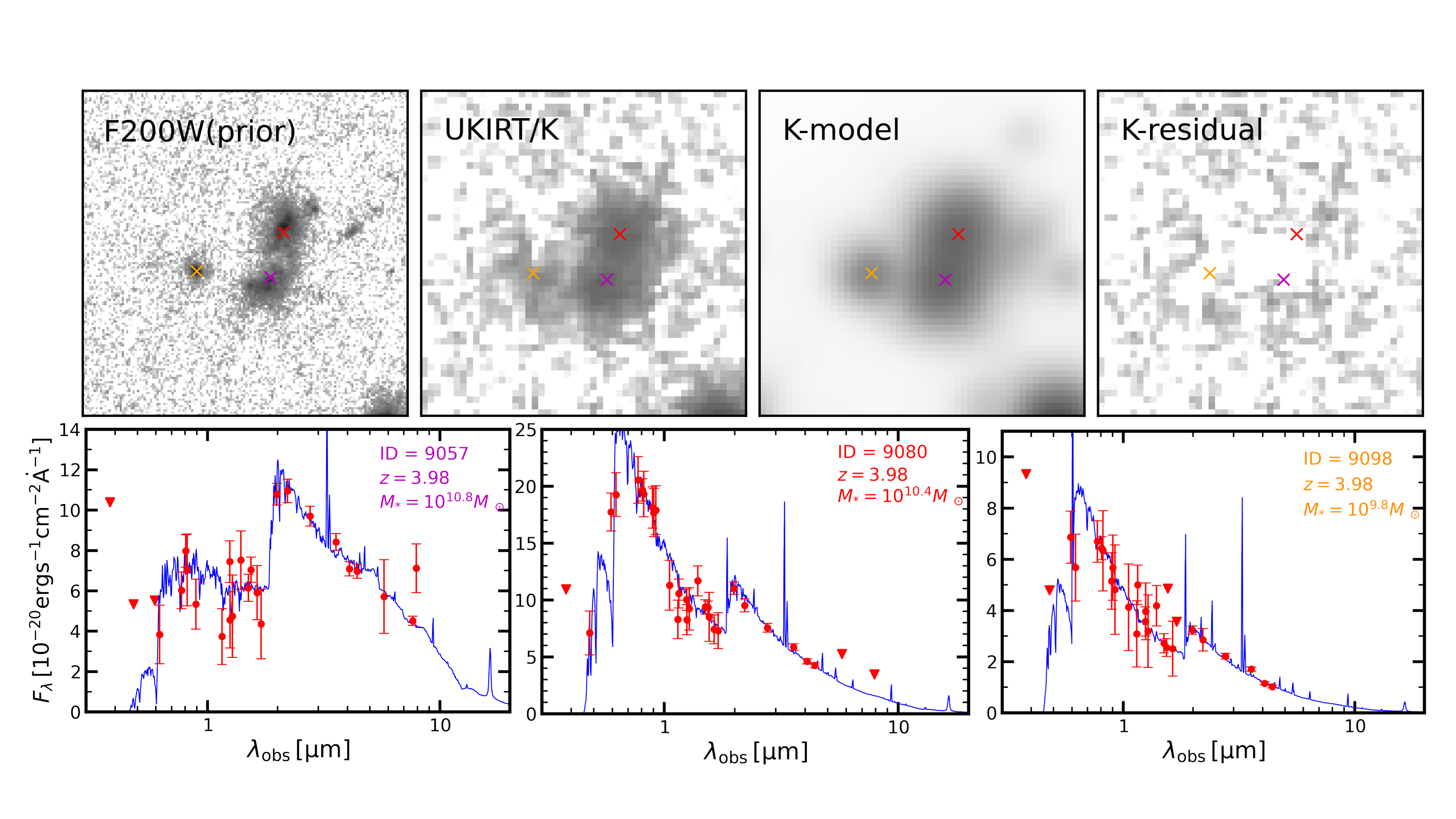
SED fitting
- Photo-z with EAZY: correct for Galactic extinction; only use SNR<2 fluxes as 3σ upper limits; adopt 5% (high-res) and 10% (low-res) error floors; use the blue_sfhz_13 template set to obtain minimum-χ² redshifts. Spectroscopic redshifts are compiled from JWST/DJA and extensive ground-based programs where available.
- Physical properties with Bagpipes: fit at fixed redshift using the 2016 revision of BC03; ages 0.03–10 Gyr; metallicity Z/Z⊙=0.01–2.5; delayed-τ SFH with τ=0.01–10 Gyr; Calzetti dust with AV=0–5 (applied separately to young/old populations); nebular emission per Byler+2017 with logU∈[−5,−2]. Outputs include M★, SFR, colors and fit diagnostics.